
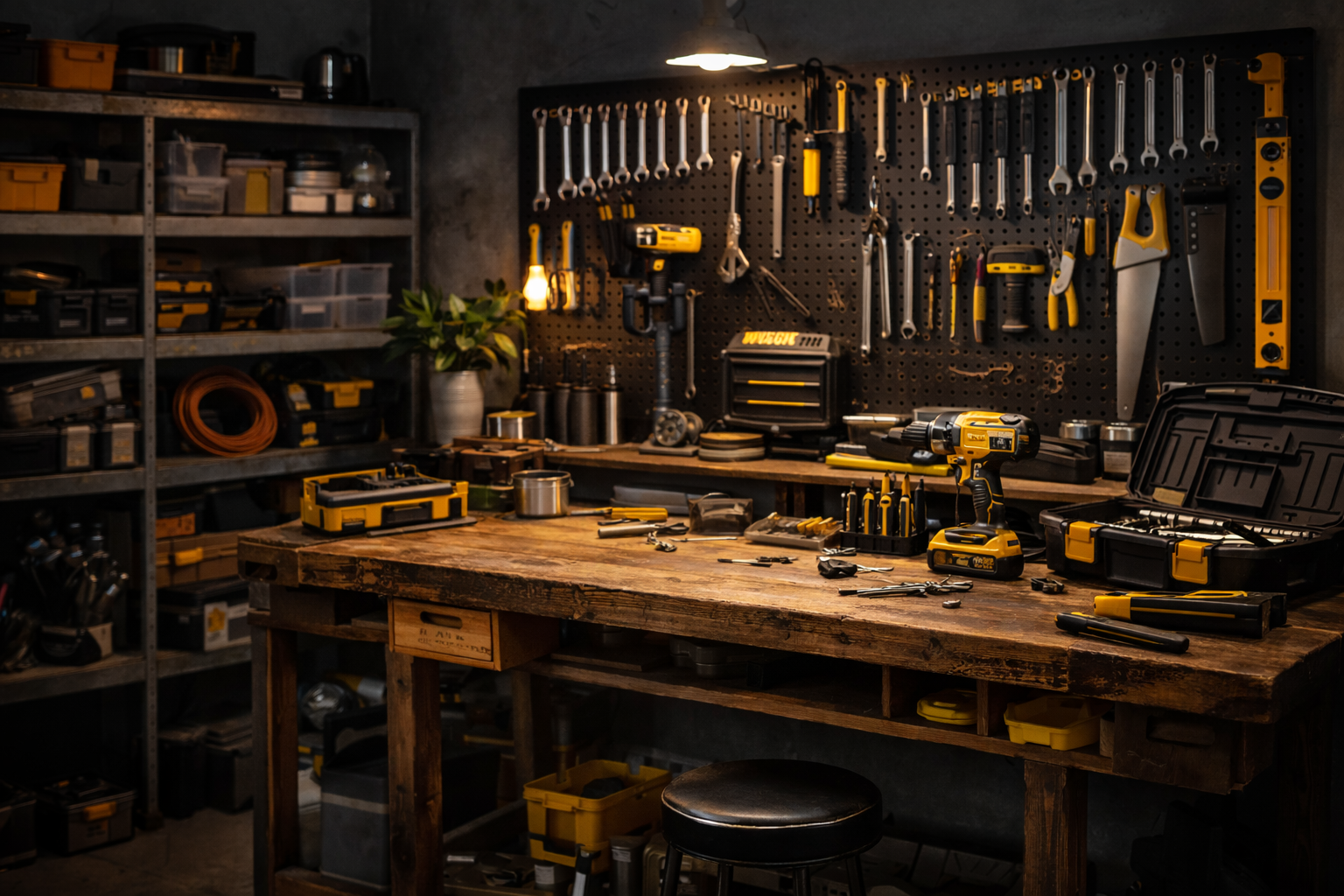
How to Set Up a Home Workshop on a Budget in Australia
Setting up your first home workshop in Australia is one of the smartest investments a homeowner can make — and it doesn’t need to cost thousands of dollars to be genuinely functional. With a clear plan, a realistic budget, and the right sequence of purchases, you can build a capable DIY workspace for under $1,500 AUD and add to it over time.
How to Set Up Your First Home Workshop — What You Actually Need
The most common mistake first-time workshop builders make is buying tools before sorting out the space. Get the environment right first — then buy tools. Here’s the order that makes the most sense financially and practically.
Step 1 — Choose and Prepare Your Space
Most Australian home workshops live in a garage, shed, or covered carport. Before buying a single tool, work through these basics:
- Size: You need at least 3m x 3m to work comfortably. Anything less and you’ll constantly be moving things to use your tools.
- Power: A standard double power point is the minimum. If you’re planning to run large power tools simultaneously, speak to a licensed electrician about a dedicated circuit. In NSW, electrical work must be done by a licensed electrician — check NSW Fair Trading for licensing requirements in your state.
- Lighting: Poor lighting causes mistakes and accidents. LED shop lights from Bunnings cost $30–$60 each and make an enormous difference. Aim for at least 500 lux over your main work area.
- Ventilation: Essential if you’re sanding, painting, or working with adhesives or solvents. A basic exhaust fan or simply keeping a roller door open works for most home setups.
- Flooring: Bare concrete is fine. Anti-fatigue matting ($20–$50 at Bunnings) makes a real difference during long sessions standing at a workbench.
Step 2 — Build or Buy a Workbench
Your workbench is the centre of the workshop. You have three realistic options in Australia:
- Buy flat-pack: Bunnings and Total Tools sell basic workbenches from $150–$300. Functional, but not as durable as a built or second-hand solid bench.
- Build your own: A simple 1.8m timber workbench can be built for $80–$150 in materials. There are hundreds of free plans online. A weekend project that results in something that lasts 20 years.
- Buy second-hand: Facebook Marketplace and Gumtree regularly list solid workshop benches for $50–$150. Worth checking before buying new.
Note on height: Workbench height should sit at roughly hip height — usually 85–92cm for most adults. Working at the wrong height causes back pain surprisingly quickly.
Step 3 — Buy These Essential Tools First
Don’t try to stock a full workshop at once. These tools will handle 80% of all home workshop tasks:
- Cordless drill/driver: Your most-used tool. Budget $100–$150 for a Ryobi or Ozito starter kit, or $280–$350 for a DeWalt or Makita brushless drill that will last far longer.
- Circular saw: For cutting timber and sheet materials. A solid entry-level model from Ryobi or Ozito runs $80–$150.
- Jigsaw: For curves, notches, and plunge cuts. Bosch and Makita make reliable options from $100–$200.
- Random orbital sander: Essential for finishing. Ryobi and Bosch offer dependable models from $50–$100.
- Measuring and marking tools: A quality tape measure, combination square, and marking pencil. Don’t scrimp here — bad measuring causes bad results.
- Clamps (minimum 4): F-clamps or G-clamps from Bunnings at $8–$15 each. You can never have too many clamps.
- Safety equipment: Safety glasses, hearing protection, and a P2 dust mask are non-negotiable. Safe Work Australia recommends appropriate PPE for all dust-generating tasks — see the Safe Work Australia wood dust guidelines.
Step 4 — Organise Your Storage
An organised workshop is a faster and safer workshop. You don’t need expensive tool cabinets to start:
- Pegboard wall panel: A 1.2m x 1.2m sheet of pegboard costs $30–$50 and keeps hand tools visible and within reach. Mount it at eye height above your bench.
- Metal shelving unit: Bunnings sells freestanding metal shelving from $60–$120. Ideal for storing power tools, materials, and finishing supplies.
- Small parts storage: Multi-bin wall-mounted units for screws, bolts, nails, and hardware. Available from $15–$30 at Bunnings.
Realistic Budget for a First Home Workshop in Australia
- Lighting: $40–$80
- Workbench (built or bought): $80–$300
- Cordless drill kit: $100–$350
- Circular saw: $80–$150
- Jigsaw: $100–$200
- Random orbital sander: $50–$100
- Hand tools, measuring, clamps: $80–$150
- Storage (pegboard + shelving): $80–$170
- Safety gear: $30–$60
- Total: $640–$1,560 AUD
Where to Buy Workshop Equipment in Australia
For most workshop essentials, Bunnings is the most convenient starting point — wide range, easy returns, and locations across every state. For better pricing on power tools, Total Tools and Sydney Tools regularly offer better deals than Bunnings on trade-grade equipment. For second-hand gear, check Facebook Marketplace and Gumtree before buying new — workbenches, clamps, and hand tools are commonly listed in excellent condition.
Disclaimer: This article contains affiliate links. If you purchase through our links we may earn a small commission at no extra cost to you. All prices listed are approximate AUD and may vary.